
This is an image depicting a historical artifact from Ancient Apulia. It appears to be a fragment of painted pottery with visible human figures on it, suggesting the representation of people in various positions or activities. The style and quality of the artwork indicate that it may have been part of a larger piece or a series. The artifact's material is not clearly identifiable from the image alone; however, based on its appearance, it could be ceramic or another type of pottery often used in ancient contexts for decoration or storage.

Chapter 9: Maria Teresa Giannotta, Apulian Pottery in Messapian Contexts
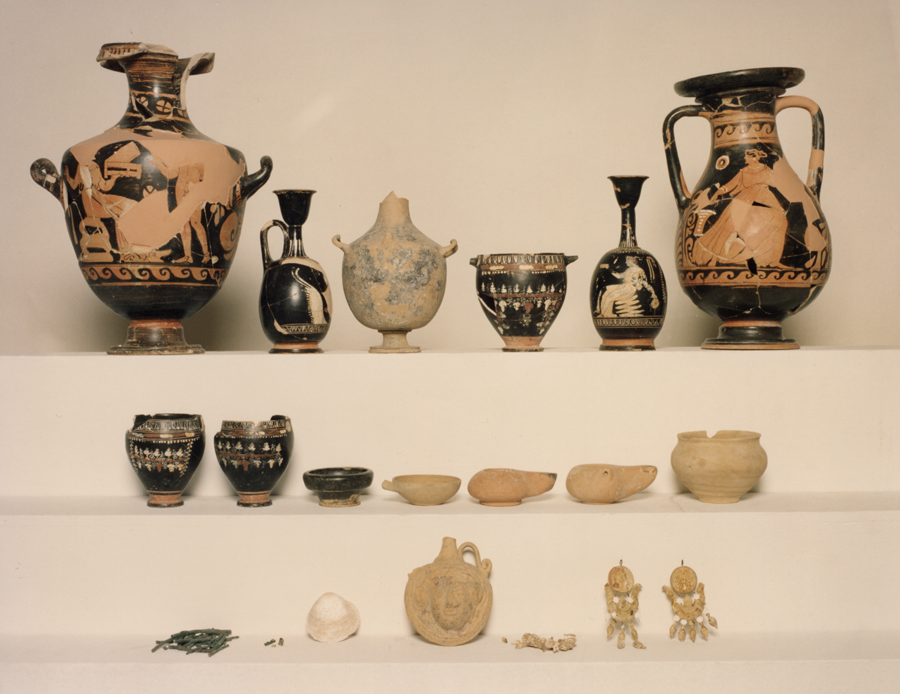
WF 113: Manduria, Tomb 515/1958. Funerary assemblage. (Soprintendenza per I Beni Archeologici della Puglia – Archivio fotografico.)
This is a photograph of an ancient Greek vase featuring a painted scene with figures, possibly gods or heroes, rendered in black-figure technique. The material appears to be earthenware with visible decoration.

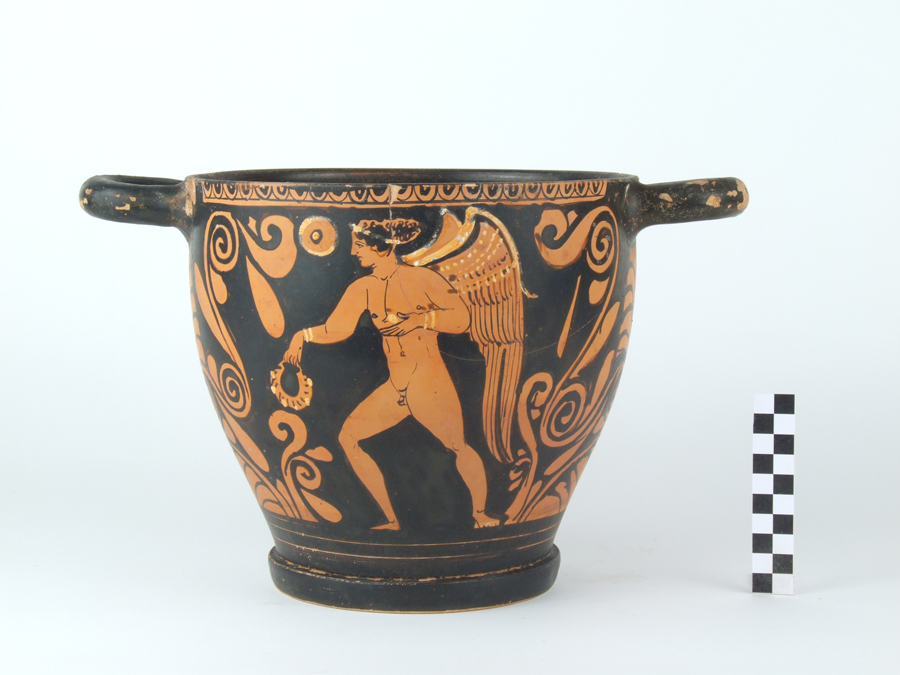
WF 114a: Skyphos by the Schlapfer Painter from Ceglie Messapica. Taranto, Museo Archeologico inv. 6400 (Courtesy Soprintendenza per I Beni Archeologici della Puglia – Archivio fotografico)
The image shows an ancient Greek terracotta pot, featuring a black-figure design with mythological figures in profile. The vessel appears intact and is displayed against a neutral background.

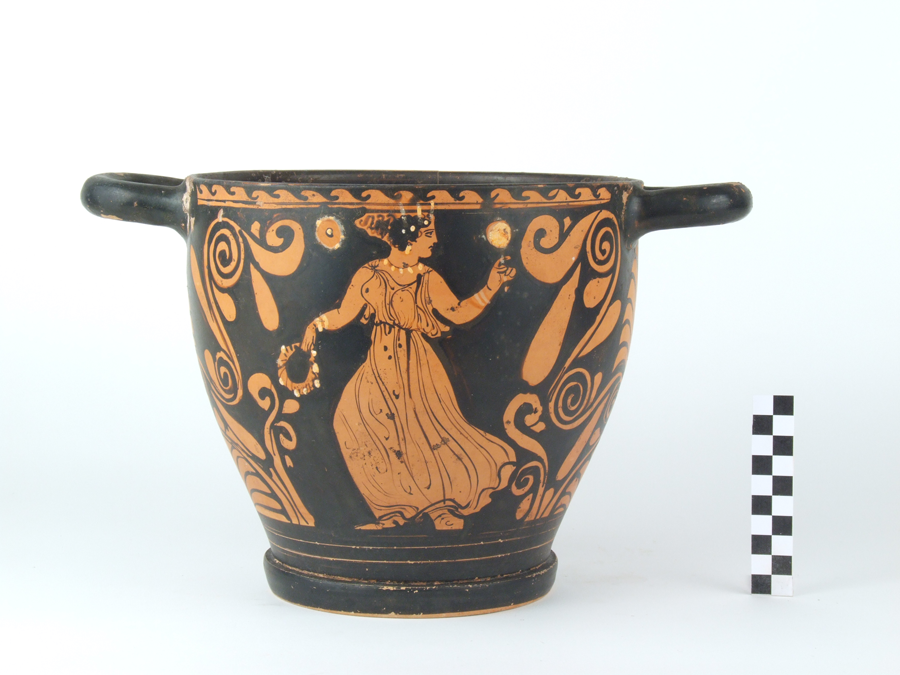
WF 114b: Skyphos by the Schlapfer Painter from Ceglie Messapica. Taranto, Museo Archeologico inv. 6400 (Courtesy Soprintendenza per I Beni Archeologici della Puglia – Archivio fotografico)
The image appears to be a map of an island with various locations marked, possibly representing points of interest or archaeological sites. The map is bordered by water and includes topographical details such as bodies of water like the Adriatic Sea and Ionian Sea, and there are labeled areas that suggest cities or regions.

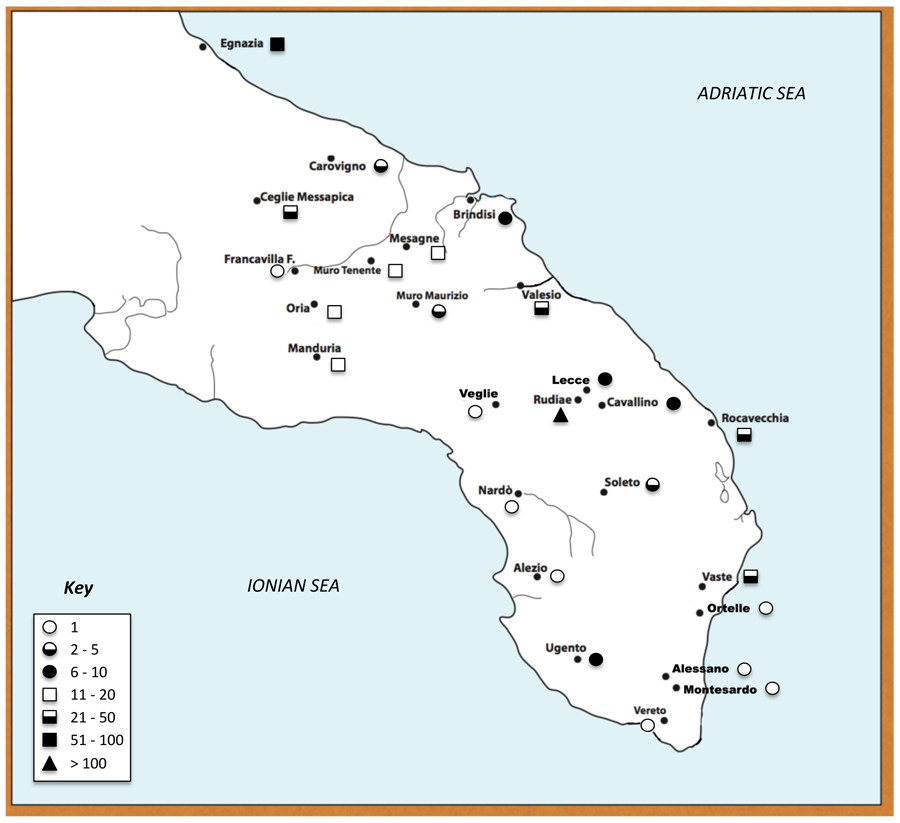
WF 115: Messapia. Map showing quantitative distribution of Apulian red-figure vases. (author)
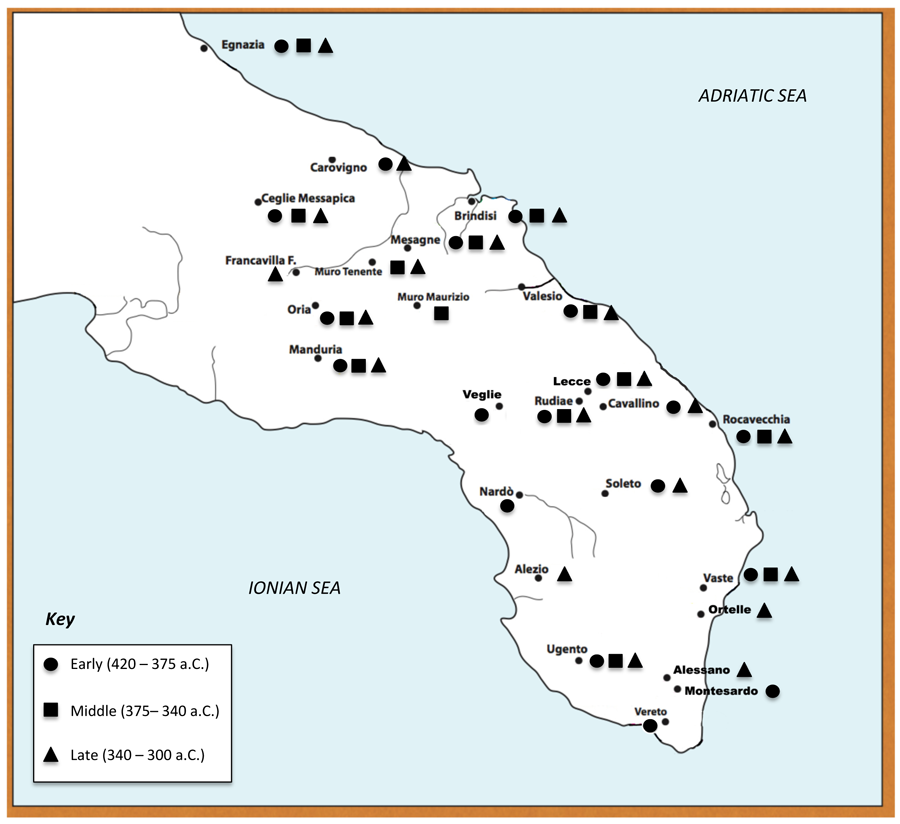
The image displays a map focusing on part of Italy with several sites marked across different time periods from early prehistory to late antiquity. These sites are likely significant for their archaeological discoveries, indicating the region's historical significance and cultural development over centuries.

WF 116: Messapia. Distribution map showing chronological phases. (author)
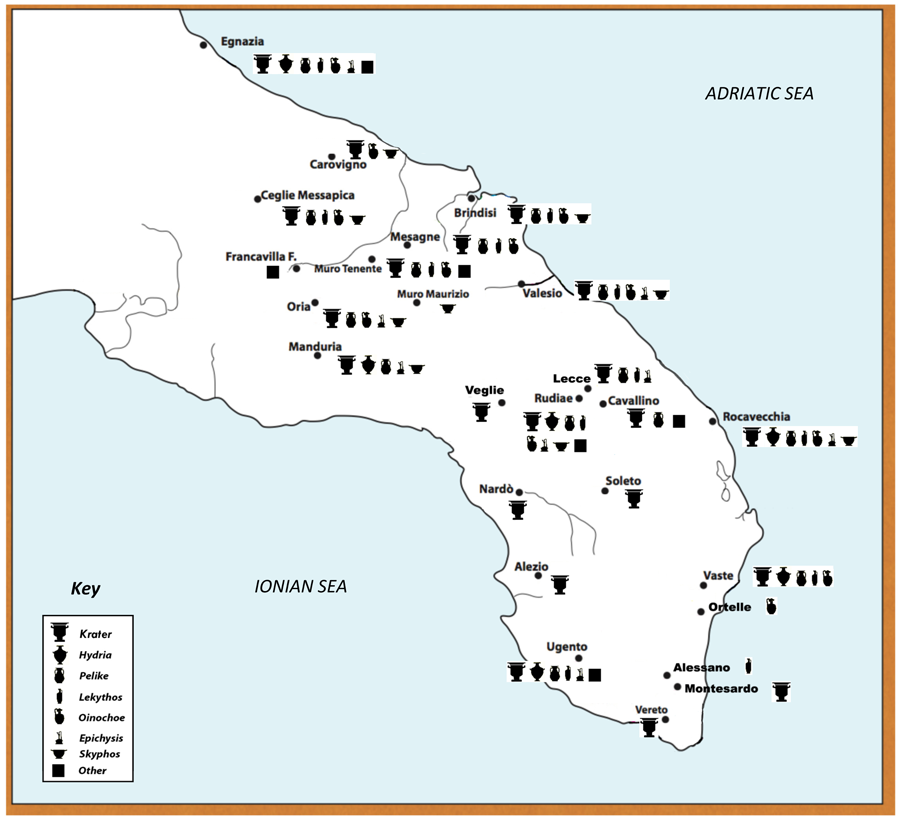
The image is a map featuring historical sites across Italy, with labels indicating their locations and possibly some names of specific sites or regions. The map is in shades of gray and white on a black background, focusing attention on the geographical layout and labeled areas.

WF 117: Messapia. Map showing distribution of shapes. (author)
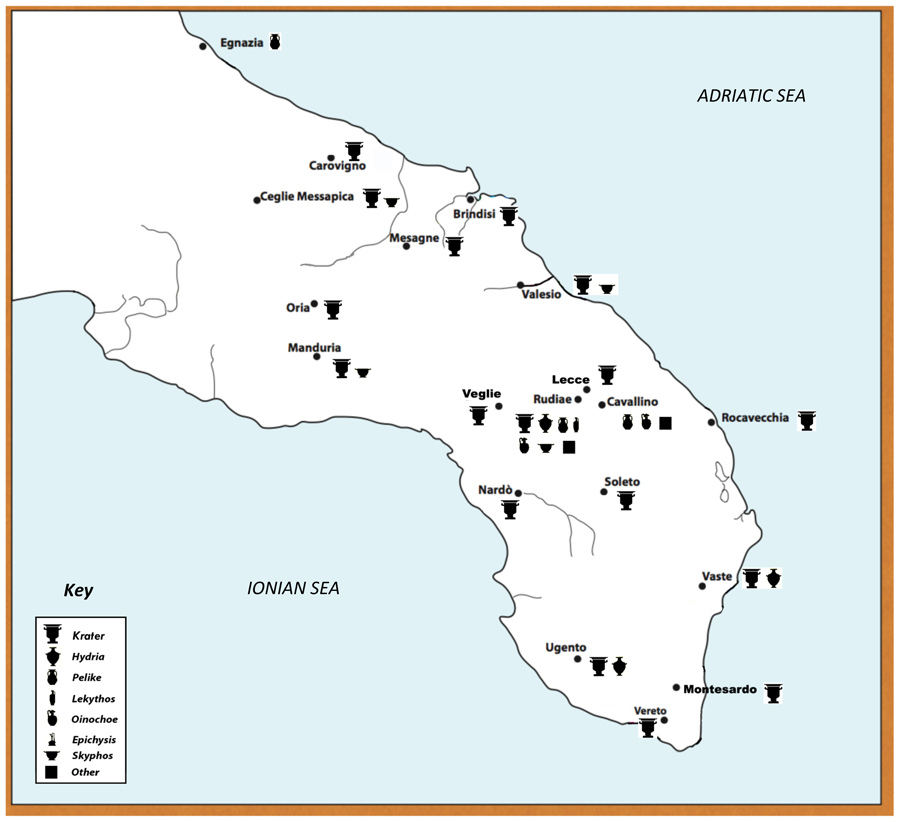
The image is a map showing the location of various archaeological sites across a region with a coastal outline, including bodies of water labeled as 'Adriatic Sea' and 'Ionian Sea'. The map uses symbols to indicate different types or purposes of these locations.

WF 118: Messapia. Map showing distribution of shapes (420-375 B.C.E.). (author)
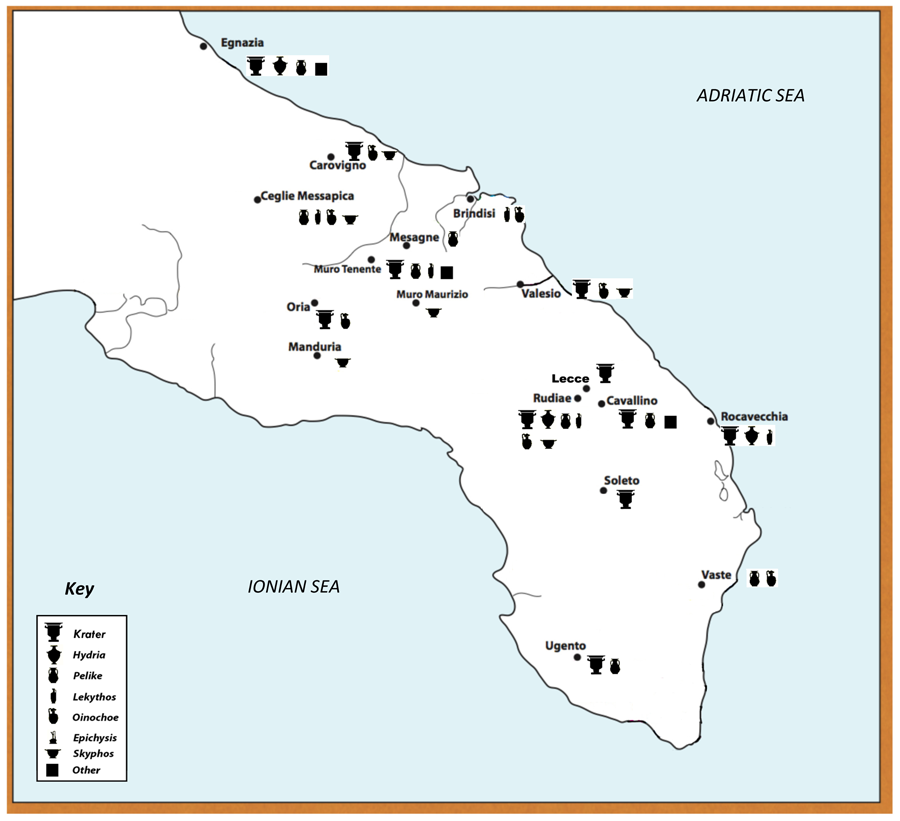
The image is a map featuring an island with various locations marked by symbols. The map shows geographical names and possibly indicates points of interest, historical sites, or other features relevant to the area depicted.

WF 119: Messapia. Map showing distribution of shapes (375-340 B.C.E.). (author)
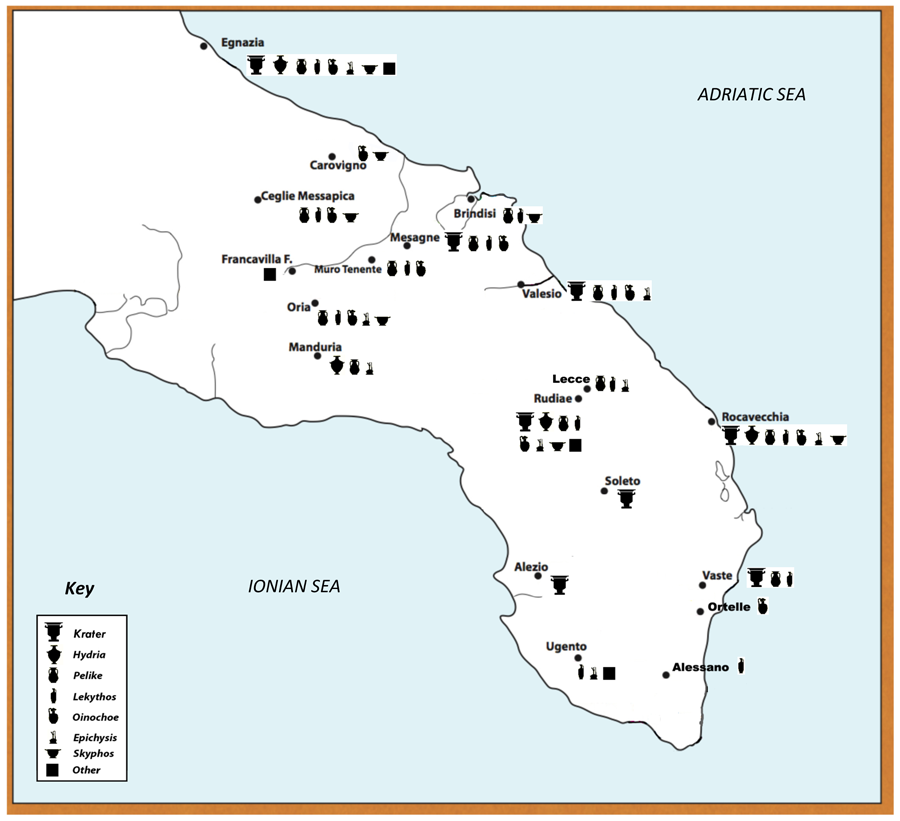
A map with various locations marked by small icons, showing different points of interest, including a sea labeled "Adriatic Sea" and other bodies of water. The map has a key explaining the symbols used for marking different types of places.

WF 120: Messapia. Map showing distribution of shapes (340-300 B.C.E.). (author)
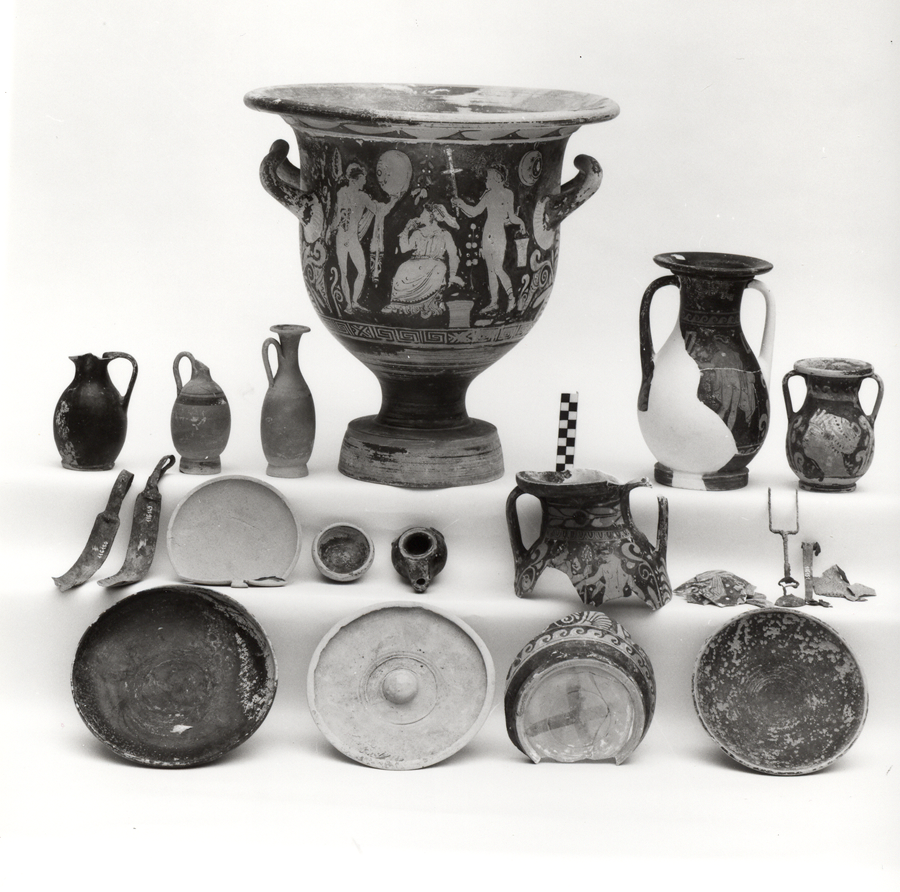
The image shows a collection of ancient Greek or Roman pottery. The artifacts include vases with painted scenes, bowls, and other vessels. Some pieces are whole, while others appear to be fragments. Key features include the classical designs visible on the surfaces, suggesting human figures and narratives, as well as the varying colors that hint at their age and exposure to elements like earth and moisture.

WF 121: Vaste. Tomb III 1959.Funerary assemblage including a bell krater by the Hoppin Painter. (Consiglio Nazionale delle Ricerche, Istituto per I Beni Archeologici e Monumentali, Lecce)
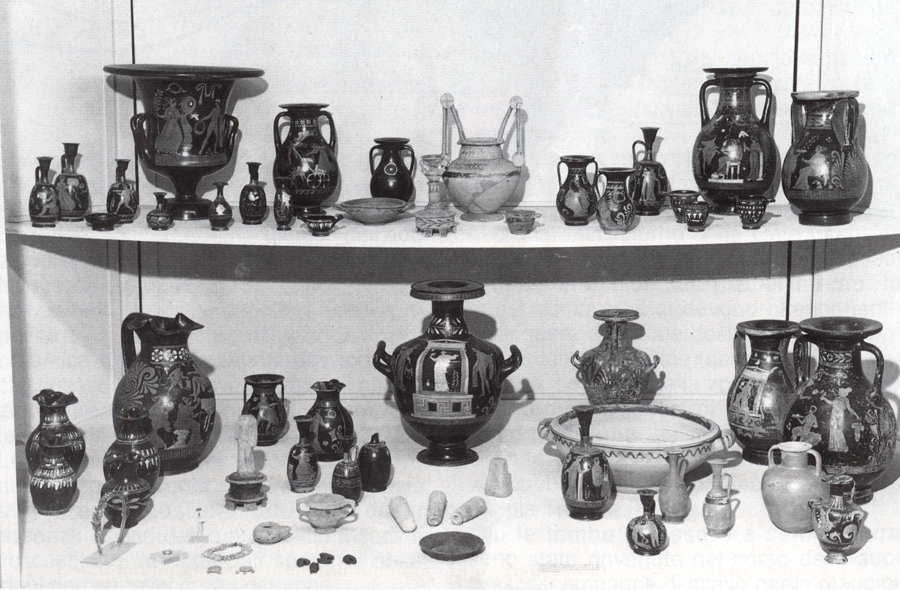
Black and white photograph showing a collection of ancient Greek vases on display, featuring various styles such as black-figure and red-figure pottery with intricate details.

WF 122: Egnazia. Funerary assemblage from a semicamera tomb discovered in 1952 (Photo Soprintendenza)
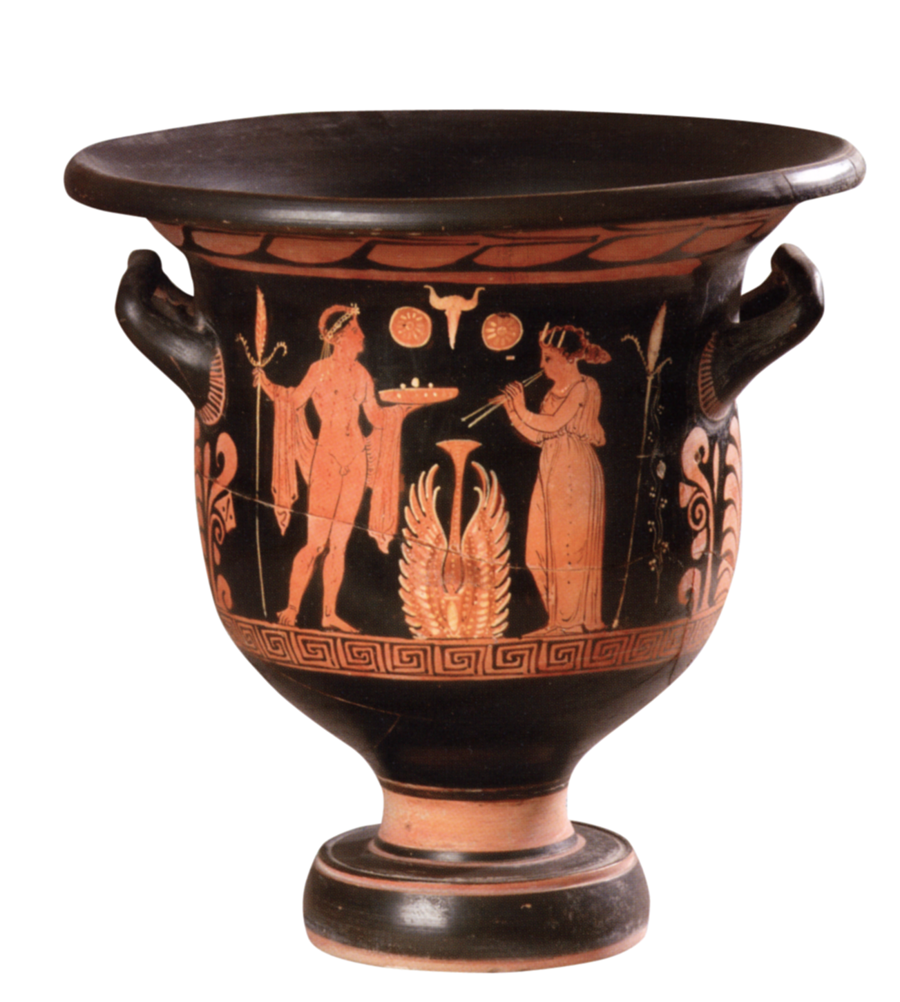
The image shows an antique Greek vase in the form of a kylix. It is a ceramic container with a wide mouth and shallow depth, characterized by its black-figure technique where figures are painted with a glossy black slip to stand out against a lighter background. The scene depicted on the vase features human figures, indicative of mythological or historical narratives common in ancient Greek pottery designs.

WF 123: Bell krater by the Snub Nose Painter from Rudiae. Lecce, Museo Provinciale 609. (Courtesy of Museo Provinciale Sigismondo Castromediano di Lecce.)
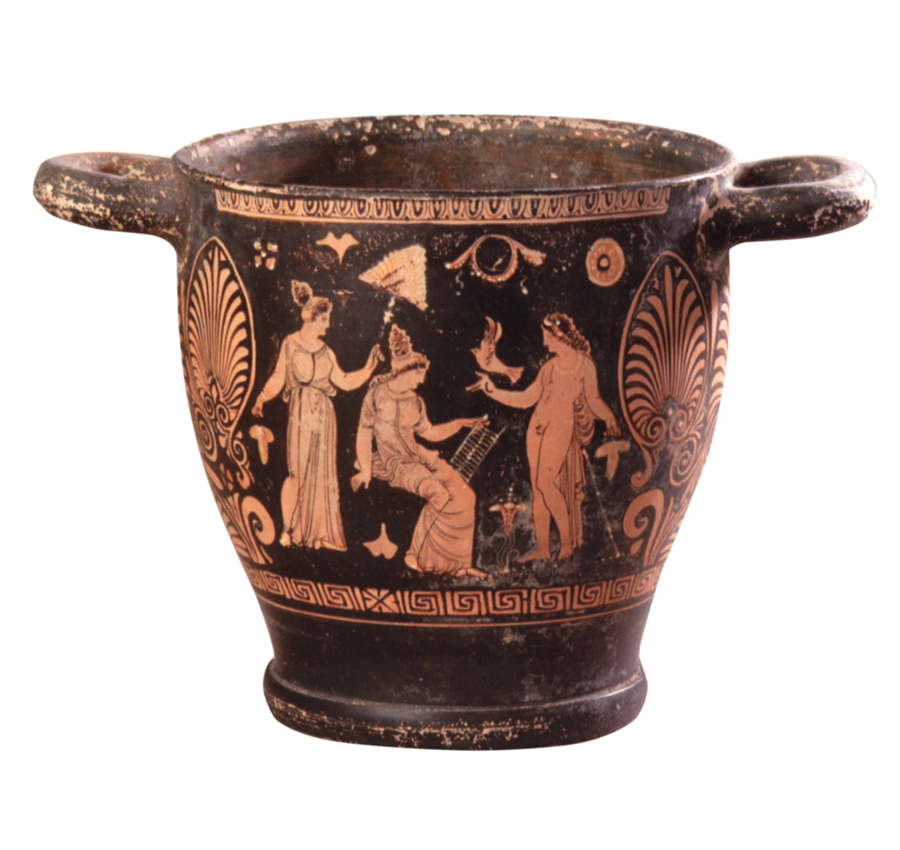
The image displays an ancient Greek amphora made from terracotta. The vase showcases intricate black-figure pottery decoration, featuring a scene with human figures engaged in various activities and adorned with floral patterns.

WF 124: Skyphos from the Gnathia Group from Rudiae. Lecce, Museo Provinciale 622. (Courtesy of Museo Provinciale Sigismondo Castromediano di Lecce.)
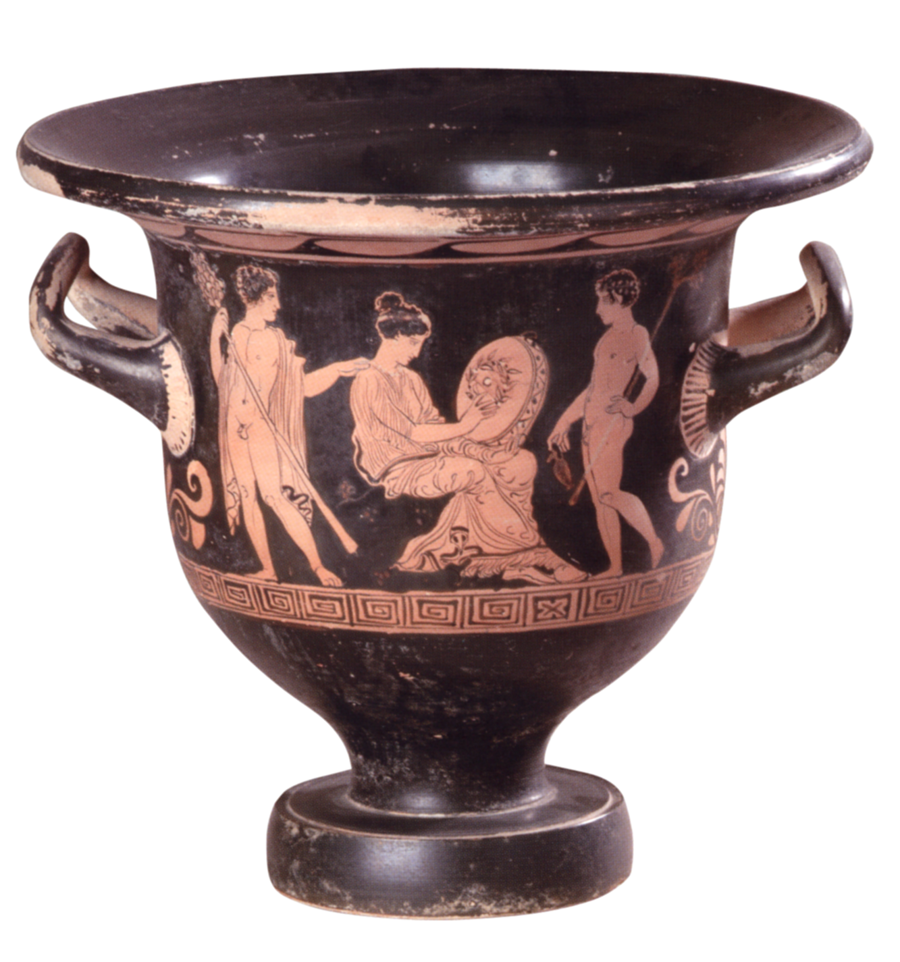
This is an ancient Greek vase painted with classical scenes in a style typical of Hellenistic art. The ceramic vessel showcases human figures, possibly gods and goddesses, engaged in various activities against a backdrop of mythological narratives.

WF 125: Bell krater by the Painter of Lecce 614 from Rudiae. Lecce, Museo Provinciale 614. (Courtesy of Museo Provinciale Sigismondo Castromediano di Lecce.)