Greek, Roman and Byzantine Pottery at Ilion (Troia):
Sebastian Heath and Billur Tekkök, Editors
Unguentaria
Please note that this is a public draft of work in progress
1. Hellenistic Fusiform Unguentarium
. P0577. Complete vessel except missing rim. Fired gray (surface = 10yr 4/1, section = 10 yr 4/1-4/2). Traces of white bands, 1 on shoulder and 1 on body.
Most similar to group B.32, which overlaps with S. Rotroff's "Atheanian Gray Unguentaria".
2. Hellenistic Fusiform Unguentarium
. P0579. Complete vessel except missing rim; joined from 9 frags. Fired gray (10yr 4/1-5/1) with self-slip hues of gray on the surface.
Most similar to group B.32, which overlaps with S. Rotroff's "Atheanian Gray Unguentaria".
3. Roman Period Piriform Unguentarium
l/m14/15.0001. P0759. Unguentarium, chipped at rim, otherwise complete.
Parallels are found in groups C.11.1 and 2.
4. Early Roman Piriform Unguentarium
t/u14.0130. P0717. Complete vessel. Orange buff (2.5YRR 6/6-7/6), micaceous fabric. Red slip around rim and neck.
Nearest to group C.33.6, for which only western Mediterranean findspots are listed.
5. Unguentarium (Late Roman)
P. H. .061. Est. diam. base .028 (almost completely preserved preserved). Th. .01.
D20.0183:6. String cut base, slightly irregular. Hard, compact, pinkish buff fabric (2.5YR 6/6) surface one tone darker.
The category of small late Roman unguentaria, also known as ampullae, was defined by Hayes (, ). More recently, examples from Ephesos have been extensively discussed (, ).
6. Ampulla in Plain Fabric (Late Roman)
P. H. .058. Est. diam. .02.Th. .002.
I17.0647:10. Single sherd preserving lower half of vessel. Compact, soft light red (10R 6/8) fabric with frequent small lime inclusions and infrequent dark bits. Surface is plain.
svg/I17.0647-10.jpg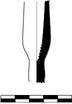
General Bibliography
Anderson-Stojanović, Virginia. 1987.
“The Chronology and Function of Ceramic Unguentaria,”
American Journal of Archaeology 91.1: 105-122.
[
online]
Hübner, Gerhild. 2006.
“Hellenistic and Roman unguentaria: Function-related aspects of the form” in
Danielle Malfitana, Joroen Poblome
and John Lund (eds.), Old Pottery in a New Century. Innovating Perspective on Roman Pottery Studies. Atti del Convegno Internazionale di Studi Catania, 22-24 Aprile 2004, Catania: 27-40.
Lochner, Susane, R. Sauer
and R. 647-654. 2005.
“Late Roman Unguentaria? - A contribution to early Byzantine wares from the view of Ephesus” in
Joseph Maria Gurt i Esparraguera, J. Buxeda i Garrigós
and M.A. Cau Ontiveros (eds.), LRCW I: late Roman coarse wares, cooking wares and amphorae in the Mediterranean : archaeology and archaeometry, Oxford: .
Metaxas, Susanne. 2005.
“Frühbyzantinische Ampullen und Amphoriskoi aus Ephesos” in
Friedrich Krinzinger (ed.), Spätantike und mittelalterliche Keramik aus Ephesos, Wein: 67-123.


