Greek, Roman and Byzantine Pottery at Ilion (Troia):
Sebastian Heath and Billur Tekkök, Editors
Early Roman Thin-walled Wares
Please note that this is a public draft of work in progress
As the name suggests, Roman Thin-Walled vessels are distinctive for the extreme thinness of their walls. As a group, they generally consist of small table vessels - cups, bowl and small jugs - that were produced in great numbers, particularly in the western Mediterranean. Italian production is in full swing by the late Republican period and Italian vessels are widey exported, including to Ilion into the first century AD. Thin-wall production becomes more distributed by the later first century AD and regional Aegean products - perhaps from workshops at Ainos - become very common. The following catalog consists of Italian and directly imitative early vessels. The very common later cups are listed separately in the section "Thin-Walled Cups/Jugs of the Roman Period". There is an extensive literature on early Thin-walled wares. The volumes by Mayet () and Marabini-Moevs (), describing finds from Iberia and from Cosa in Italy, provide useful typologies.
1. Sanded Ware Cup Rim (1st Century AD)
P. H. .065. Est. diam. rim .095 (<1/20 preserved). Th. .003.
K/L16/17.0461:17. Single rim to lower body preserved. Bowl with high walls, rounded towards base. Fine pink (10R 7/6) fabric, very slightly lighter and finer than K/L16/17.0467:03 but both are probably from the same source. Red slip (near 10R 4/8) on interior and exterior. Sand particles unevenly spaced below slip.
svg/K-L16-17.0461-17.jpg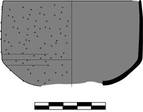
2. Sanded Ware Cup Handle (Early to Mid-first Century AD)
Z06.0007:33. SC09-3m. Single sherd with handle. Sand on lower extant exterior.
First published as , no. 29. Cf. Form XLII.
svg/z06.0007-33.jpg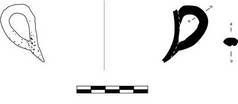
3. Sanded Ware Bowl Rim (Mid-first Century AD?)
I17.0757:2. SC09-3j. Single rim sherd. Sand on exterior below reserved band.
See examples at B459 for similar form and sanding.
svg/I17.0757-2.jpg
4. Dot-decorated Beaker (150 - 50 BC)
D09.2037:2. SC07-7j. Single body sherd. Dotted arcs on exterior surface.
Cf. Form I, Group A, plates; plates 1 and 55.
5. Thin Walled Cup Rim (late Republican to Augustan)
H17.0916:16. SC07-7h. Single rim sherd. Micaceous yellowish/buff fabric (7.5 YR 6/4-6/6). Very thin walls. Swelling rim.
Cf. form 4; nos. 36 and 37, illustrated on plates 4 and 57; also plate 100. no 3 (from the Ciacchi excavation House of Livia).
svg/H17.0916-16.jpg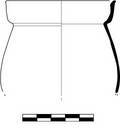
6. Thin Walled Beaker (1st Century AD)
M18.0478:1. P.H. .0513, est. D. rim .09 (<1/12 preserved), th. wall .0019. Grey (GLEY1 5/) core with angular quartz and rounded lime inclusions. Interior surface and lower outer surface are light red (around 2.5YR 5/8). Gray band below rim on exterior. Rim has distinct exterior groove making for a very delicate bead at lip.
M18.0478-1.jpg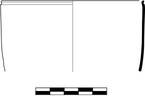
7. Thin Walled Cup, "Thorn Ware" (Early 1st Century AD)
P. H. .029. Est. diam. rim .06 (1/5 preserved). Th. .0012.
M18.0478:2. Single rim sherd with upper body and handle stub. Cleanly fired red (2.5YR 5/6) fabric with relatively few tiny light inclusions. Applied barbotine decoration. Finely articulated rim. A small amount of excess clay over rim.
Cf. Form IV and VII, no. 84; plates 8 and 59; perhaps transitional to Tiberian form LI. Cf. no. 288.
M18.0478-2.jpg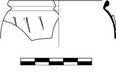
8. "Thorn Ware" Thin Walled Cup Base (1st Century BC and Later)
H17.0896:1. Single base sherd. Added decoration starting at base.
First published as , no. 35.
H17.0896-1.jpg
General Bibliography
Carandini, Andrea. 1977.
“La ceramica a pareti sotili di pompei e del Museo Nazionale di Napoli” in
Andrea Carandini (ed.), La ceramica a pareti sotili di pompei e del Museo Nazionale di Napoli: 25-31.
Hayes, John. 1976.
Roman Pottery in the Royal Ontario Museum. Toronto.
[
worldcat.org]
Kenrick, Philip. 1985.
Excavation at Sidi Khrebish Benghazi (Berenice). Volume III, 1 Supplements to Libya Antiqua 5. Tripoli.
[
worldcat.org]
Marabini Moevs, Maria Teresa. 1973.
The Roman Thin Walled Pottery from Cosa (1948-1954) Memoirs of the American Academy in Rome 32. Rome.
[
worldcat.org]
Mayet, Françoise. 1975.
Les céramiques a parois fines dans la Péninsule Ibérique Publications du Centre Pierre Paris 1. Paris.
[
worldcat.org]
Mayet, Françoise. 1980.
“Les céramiques a parois fines: état de la question” in
Pierre Lévêque
and Jean-Paul Morel (eds.), Céramiques Hellénistiques et Romaines, Paris: 201-229.
Rizzo, Giorgio. 2003.
Instrumenta Urbis I. Ceramiche fine da mensa, lucerne ed anfore a Roma nei primi due secoli dell'impero Collection de l'École française de Rome 307. Rome.
[
worldcat.org]


