Greek, Roman and Byzantine Pottery at Ilion (Troia):
Sebastian Heath and Billur Tekkök, Editors
Various Sigillatas
Please note that this is a public draft of work in progress
This section includes Roman period sigillatas with minimal representation at Ilion and sherds whose attribution is tentative.
1. “Brown Slip” Sigillata Plate Base (Early Roman)
P. H. .021. Est. diam. base .08 (<1/10 preserved). Th. .004.
K/L16/17.0427:25. Single sherd, ring foot. Fine brown (5YR 6/6 and slightly redder) fabric with rounded white (lime?) and smaller angular inclusions. Extant interior floor is slipped and varies in color from red to very dark reddish brown (10R 5/8 to 3/3). The slip is thickly applied but not very well smoothed with small bumps remaining under the slip. There are two interior concentric bands of rouletting just inside and outside the circumference of the base.
svg/K-L16-17.0427-25.jpg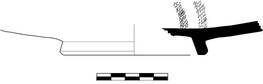
2. “Brown Slip” Sigillata Bowl (Early Roman)
P. H. .087. Est. diam. rim .41 (1/10 preserved). Th. .0084.
K17.0860:3. Single large rim sherd. Light brown fabric (5YR 6/6) is compact with occasional rounded white inclusions (.004 in size) and other angular bits of similar size; there are also tiny bits visible at 10x. Thick brown slip (just lighter than 5YR 4/6) on all surfaces. Surfaces are brushed and darker where slip is thickest. As usual for the ware, there are “flattened bumps” under the interior slip, which is darkest over bumps. Two grooves on exterior wall.
3. “Brown Slip” Sigillata Bowl (Early Roman)
P. H. .037. Est. diam. base .16 (<1/10 preserved). Th. .008.
K/L16/17.0434:2. Single base sherd. Compact, hard, well-fired light red (2.5YR 6/6) fabric with some varied tiny inclusions and occasional tiny voids. The interior surface has a “bumpy” reddish-brown slip (2.5YR 5/8 and darker) that shows the unevenness of the vessel surface. The plain exterior surface is fired to consistent light brown (7.5YR 7/6) and is quite well smoothed except for the occasional bit of excess clay or surface void. The groove and ridge that set the base off from the exterior wall are sharply defined.
svg/K-L16-17.0434-2.jpg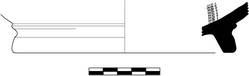
4. Lesbian Sigillata(?) Portrait Bowl (later 1st Century BC to Augustan)
K/L16/17.1516. P0639. Single sherd. Thin, fugitive slip on pinkish fabric. Portrait left.
Cf. , , p. 97-98, and .
5. Lesbian Sigillata(?) Bowl
H. .034. Est. diam. base .11. Th. .0039.
K17.0978:31. Single base sherd. Soft, fine pink (2.5YR 7/6) fabric with tiny angular light inclusions. Thin red (10R 5/8) matte slip on extant interior. Exterior plain. Ridge separates wall from floor on interior. Slight offset inside of this ridge. Groove separating base from floor on exterior.
K17.0978-31.jpg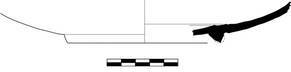
6. Lesbian Sigillata(?) Bowl Rim
H. .027. Est. diam. rim .11 (1/10 preserved). Th. .005.
K/L16/17.0427:26. Single rim sherd. Fine pale red/light brown (5YR 7/6 and redder) fabric with frequent tiny white inclusions. The now worn, thin and red (10R 5/8) slip is very thinly, but evenly, applied to all extant surfaces. Thickened, outturned rim, slight interior carination dividing wall and floor.
svg/K-L16-17.0427-26.jpg
7. Unclassified Sigillata Bowl (Early Roman)
H. .02. Est. diam. base .08 (<1/10 preserved). Th. .004.
K/L16/17.0427:24. Single sherd. Compact, hard reddish-brown (2.5YR 6/8) fabric with tiny angular inclusions of varied lightness just visible to the naked eye. The red (10R 4/6) slip does not completely hide the slight smoothing ridges on the interior, but is otherwise thick in places. Surface is pocked but slip may not have been highly polished. The exterior is plain. Flaring, well-made ring foot. One band of circular rouletting on the interior floor.
svg/K-L16-17.0427-24.jpg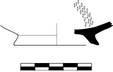
8. Unclassified Sigillata Bowl Base (Early Roman)
H. .028. Est. diam. base .06 (1/5 preserved).
K/L16/17.0427:22. Single base sherd. Fine pink (2.5YR 7/6) fabric with occasional tiny varied inclusions and one .001 bit of lime observed in extant part of vessel. Thick, smoothed red (near 10R 4/6) slip on interior, thinner application of same on exterior. Rouletting on interior floor. Flaring false-ring foot. Slight offset on exterior wall at base.
Cf. , nos. 1165 and 1342 on plate 56.
svg/K-L16-17.0427-22.jpg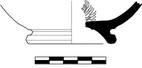
9. Unclassified Sigillata Bowl Base (Early Roman)
H. .028. Est. diam. base .08 (1/10 preserved).
K/L16/17.0427:23. Two joining sherds preserve base and lower wall. Fine brown (5YR 6/6) fabric with occasional tiny darker inclusions. Thick, well-smoothed red (between 10R 5/8 and 4/8) slip on interior, thinner on exterior.
Cf. , nos. 1165 (but no rouletting).
svg/K-L16-17.0427-23.jpg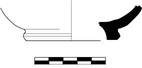
10. Unclassified Sigillata Beaker(?) Fragment (Early Roman)
H. .042. Th. .004.
K/L16/17.0427:27. Single body fragment, stance and orientation uncertain. Fine Reddish-brown (2.5YR 6/8) fabric with infrequent, tiny, both light and dark, inclusions visible at 10x magnification. The extant surfaces are covered with a thick brown (10R 5/6) slip that retains some bands of fine brush marks but is otherwise smoothed. A band of rouletting is partially preserved below carination that separates the upper and lower walls.
Cf. , plate 60 for similar surface treatment in Assos "Lokale Ware".
svg/K-L16-17.0427-27.jpg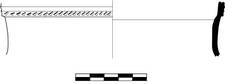
Related Resources for Catalog
These links provide well-known identifiers for concepts appearing in this catalog.


