Greek, Roman and Byzantine Pottery at Ilion (Troia):
Sebastian Heath and Billur Tekkök, Editors
Roman-Period Cooking Vessels
Please note that this is a public draft of work in progress
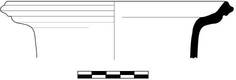
Roman-period cooking vessels at Ilion, of which only a small selection is presented here, have many parallels with those known in western Asia Minor generally (e.g. ) and with later types published from Didyma (). The catalog begins with Phocaean cookware vessels, which become common in the second half of the first century AD. These are recognized by their relatively pink fabric and golden mica. Their construction is also more careful than that of more regional products, with thinner walls and more sharply formed divisions between rim and wall. Özyiğit (, , ) publishes the evidence for production of these vessels at Phocaea. Three forms of low-dish are common at Ilion in the first through third centuries AD. A "frying pan" pan with flaring walls continues late Hellenistic versions of the same. A single handle is occasionally preserved. A "baking dish" with everted rim is present in 1st through 3rd century deposits. "Flanged-casseroles" with slightly incurved rims appear in a gritty gray fabric that may well be of local or very regional manufacture. This form appears in the late 2nd century at the earlist. Tekkok () and and Kozal () publish additional examples of Roman-period cooking vessels. Within this preliminary typology, the first two forms are well known at Knossos ().
1. Phocaean Cookpot
P. H. .03. Est. diam. rim .13 (1/10 preserved). Th. .003.
K/L16/17.0461:18. Single sherd of rim and upper wall. Thickened triangular rim with ridges on outer face. Brown fabric (2.5YR 5/8) with frequent white inclusions and golden mica. Gray exterior surface. Interior same as fabric.
For form see no. 85.
svg/K-L16-17.0461-18.jpg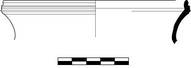
2. Phocaean Cookpot, Inverted and Ridged Rim
P. H. .033. Est. diam. rim .15 (1/10 preserved). Th. .0025.
K/L16/17.0434:11. Single rim sherd. The compact reddish brown (near 2.5YR 5/8) fabric has frequent tiny white inclusions and less frequent darker ones, golden mica in fabric and on surface. The surface of this sherd is very worn but where preserved is gray (2/5YR 5/2).
Form near no. 84, though slightly more rounded.
svg/K-L16-17.0434-11.jpg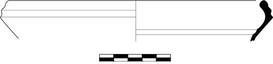
3. Phocaean Cookpot, Inverted and Ridged Rim
P. H. .029. Est. diam. rim .145 (1/7 preserved). Th. .002.
K/L16/17.0434:4. Single rim sherd. Slightly granular, dark reddish-brown (2.5YR 5/8) fabric with frequent tiny to small white inclusions and golden mica, some flattened on surface. Interior is plain. Exterior is gray.
For form see no. 84.
svg/K-L16-17.0434-4.jpg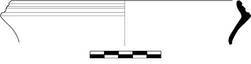
4. Phocaean Cookpot, Flaring Rim (Early Roman)
P. H. .058. Est. diam. rim .22 (1/10 preserved). Th. .003.
K/L16/17.0120:13. Two joining rim sherds. Slightly granular brown (5YR 4/4) fabric with frequent angular white inclusions and occasional golden mica flattened on surface. Surface dark gray (2.5Y 4/1) with much thinner slip on lower part of preserved exterior. Shallow, broad ridges on exterior.
For form see no. 80.
svg/K-L16-17.0120-13.jpg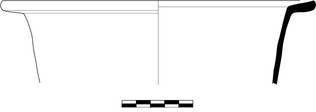
5. Phocaean Cookpot Rim and Handle, upturned rim
P. H. .087. Est. diam. rim near .28 (<1/10 preserved). Th. .004.
K/L16/17.0144:3. Two sherds, rim and handle. The fabric of this vessel is compact with frequent elongated light and rounded dark inclusions; orange (2.5YR 6/8) towards the interior surface and browner (7.5YR 6/4) towards the exterior. The exterior surface is gray. Slight ribbing is evident on the extant wall, an unusual feature in Phocaean vessels as found at Ilion.
Cf. , no 80; type T9, p. 86.
svg/K-L16-17.0144-3.jpg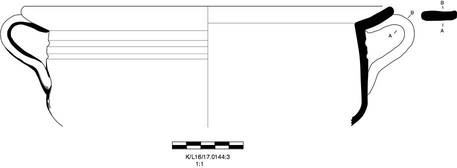
6. Phocaean Globular Cookpot, upturned rim
P. H. .027. Est. diam. rim .15 (1/4 preserved). Th. .003.
K/L16/17.0114:47. Ten sherds, six joining with rim, and four probably from same vessel. The vessel has been discolored by heat, either before or after deposition. The original pale red (2.5YR 6/6) color of the fabric is preserved near the rim. Inclusions consist of angular quartz and smaller varied bits.
Cf. T4.
svg/K-L16-17.0114-47.jpg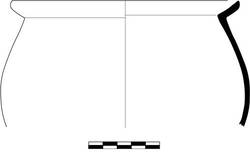
7. Cooking Pan (Early Roman)
P. H. .053. Est. diam. rim .28 (1/10 preserved).
K/L16/17.0100:32. Single sherd, rim to just below carination/floor. Granular reddish-brown (2.5YR 5/4) fabric with frequent small light inclusions. Surface gray. The vessel is not flat below the carination so no part of the floor is extant.
Cf. P29, but with no groove on rim.
svg/K-L16-17.0100-32.jpg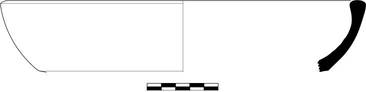
8. Gritty Gray Cookingware Flanged Casserole
P. H. .049. Est. diam. rim .026 (<1/10 preserved). Th. .006.
K/L16/17.0118:16. Single rim sherd to floor. The coarse fabric has a reddish-brown (2.5YR5/6) core, darker towards burned exterior. The interior surface is pink (10R 6/6). The outer wall is lightly ridged. Distinct ridge to hold lid.
svg/K-L16-17.0118-16.jpg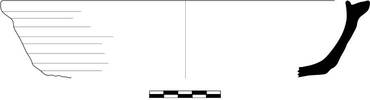
9. Gritty Gray Cookingware Flanged Casserole
P. H. .036. Est. diam. rim .30 (<1/10 preserved). Th. .007.
K/L16/17.0434:15. Single rim sherd, incurved rim. Coarse brown (7.5YR 4/3) fabric with frequent sandy light and dark bits.
svg/K-L16-17.0434-15.jpg
10. Phocaean Flanged-Casserole (Early Roman)
H. .06. Est. diam. rim .26. Est. diam. base .22.
C29.0452. P0475. Complete. Orangeish buff fabric (between 7.5YR 6/4 and 6/6), with gold and silver mica. Smoothed surface, partially burned. Irregular bottom. Pressed clay around the rim in two parts.
First published as no. 91. From the Hadrianic deposits of the C29 well.
svg/P0475.jpg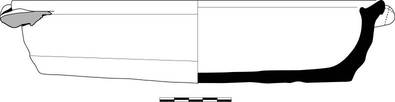
11. Phocaean Flanged-Casserole Rim to Floor (Early Roman)
P. H. .04. Est. diam. rim .37 (1/10 preserved). Th. .008.
K/L16/17.0132:7. Single rim sherd. Greenish gray (2.5Y 7/2) fabric may be discolored from use. The inclusions range from angular quartz to varied small light and dark bits, with frequent mica.
Similar form at no. 91.
svg/K-L16-17.0114-11.jpg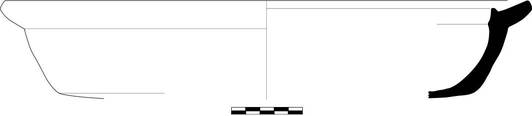
12. Gritty Gray Cookingware Flanged Casserole
P. H. .049. Est. diam. rim .30 (1/12 preserved). Th. .0084.
K/L16/17.0100:34. Single rim sherd. Coarse brown (2.5YR 4/4) fabric with frequent, mostly light sand angular inclusions. Surface near black. Light exterior ridging.
svg/K-L16-17.0100-34.jpg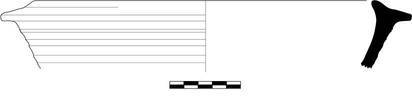
13. Gritty Gray Cookingware Flanged Casserole
P. H. .045. Est. diam. rim .24 (<1/10 preserved). Th. .0073.
K/L16/17.0100:33. Single rim sherd. Coarse brown (2.5YR 4/4) fabric with very frequent, mostly light and reddish sand angular inclusions. Surface near black. Very light exterior ridging.
svg/K-L16-17.0100-33.jpg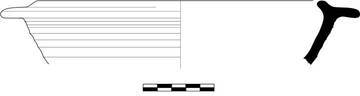
14. Gritty Gray Cookingware Flanged Casserole
P. H. .042. Est. diam. rim .21 (1/10 preserved). Th. .008.
K/L16/17.0417:14. Single sherd preserves <1/10 rim circumference. P.H. .042, est. D. rim near .22, Th. wall .008. Single rim sherd. Coarse brown (7.5YR 4/4) fabric with frequent large angular white chunks and smaller angular light and dark bits. Surface is coated reddish-brown (2.5YR 5/3 and lighter).
Cf. P51.
svg/K-L16-17.0417-14.jpg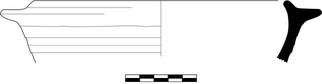
15. Gritty Cookingware Casserole
P. H. .053. Est. diam. rim .22 (1/5 preserved). Th. .0072.
K/L16/17.0084:13. Single rim sherd. Coarse varied reddish-brown (near 5YR 5/3) with frequent light angular inclusions. The surface is fired pale red (around 10R 6/4). [[drawing needs to be traced]]
Cf. P51.
16. Gritty Gray Cookingware Flanged Casserole
P. H. .051. Est. diam. rim .30 (1/7 preserved). Th. .0055.
K17.0845:3. Single rim sherd, flange and inturned rim to lower floor. Brown (5YR 4/6) fabric with occasional large quartz, up to .001, and frequent angular light bits. All preserved surfaces are a uniform dark gray. Exterior is ridged.
Cf. P51.
svg/K17.0845-3.jpg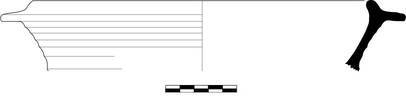
17. Gritty Gray Cookingware Flanged Casserole
P. H. .06. Est. diam. rim .28 (1/5 preserved). Th. .0067.
K/L16/17.0106:1. Single rim sherd. Coarse fabric with frequent angular quartz/sand inclusion. Greenish-brown core (10YR 5/3), brown layer (5YR 5/6), blackened surfaces.
Cf. P51.
svg/K-L16-17.0106-1.jpg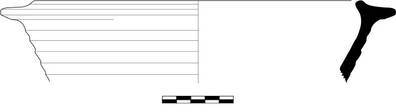
18. Gritty Gray Cookingware Flanged Casserole
P. H. .068. Est. diam. rim .23 (1/10 preserved). Th. .009.
K17.0777:35. Single rim sherd. Coarse, dark brown fabric (5YR 4/4) with frequent large angular and sub-angular quartz, up to .002, inclusions as well as varied other angular bits. Surfaces are near black. Rim is slightly overhanging. No ridges on exterior.
Cf. P51.
K17.0777-35.jpg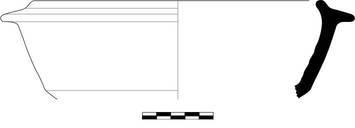
19. Gritty Gray Cookingware Flanged Casserole
P. H. .068. Est. diam. rim .22 (1/10 preserved). Th. .009.
M18.0612:1. Single rim sherd. Dark brown fabric (5YR 4/4) with frequent large angular and sub-angular quartz, up to .002, inclusions as well as varied other angular bits. Surfaces are near black. Rim is slightly overhanging.
Cf. P51.
M18.0612-1.jpg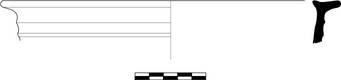
20. Gritty Gray Cookingware Flanged Casserole
P. H. .029. Est. diam. rim .26 (1/12 preserved). Th. .0057.
M18.0099:13. Coarse fabric is black, perhaps from use. Inclusions consist of frequent angular and rounded small light lime and quartz and surrounding tiny bits. Surface is reddish gray (around 5YR 5/2). Incurved lip is distinctly tooled. Exterior lightly ridged.
Cf. P51.
M18.0099-13.jpg
21. Gritty Gray Cookingware Flanged Casserole
P. H. .054. Est. diam. rim .18 (1/10 preserved). Th. .0063.
M18.0099:11. Single rim sherd. Fabric is mostly black, perhaps from use, with parts remaining very dark brown. Inclusions and surface as #10, though with occasional large angular .002 chunks of quartz visible.
Cf. P51.
M18.0099-11.jpg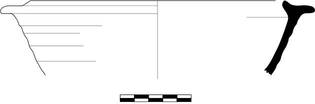
22. Gritty Gray Cookingware Flanged Casserole
P. H. .028. Est. diam. rim .18 (1/12 preserved). Th. .004.
M18.0099:9. Single rim sherd. Coarse brown (5YR 5/4) fabric with frequent small light inclusions and frequent varied bits. Surface coated and just darker (5YR 5/3), exterior narrowly ridged.
Cf. P51.
M18.0099-9.jpg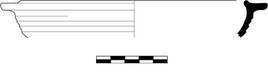
23. Gritty Gray Cookingware Flanged Casserole
P. H. .04. Est. diam. rim .17 (1/8 preserved). Th. .005.
M18.0099:10. Single rim sherd. Coarse fabric is black with a feint reddish brown (5YR 3/3) core, probably from use. Inclusions consist of frequent angular and rounded small light lime and quartz and surrounding tiny bits. Surface is coated black and slip contains mica flattened by turning. Exterior is lightly ridged.
Cf. P51.
M18.0099-10.jpg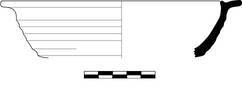
24. Gritty Gray Cookpot (Early Roman)
P. H. .039. Est. diam. rim .16 (1/12 preserved). Th. .0057.
K/L16/17.0120:21. Single rim sherd, with upper wall. Gray (2.5YR 5/1) farbic with distinct redder (2.5YR 6/6) layering in thickened rim. Angular quartz inclusions and frequent lighter bits.
Similar form at no. 78 and no. 111.
svg/K-L16-17.0120-21.jpg