Greek, Roman and Byzantine Pottery at Ilion (Troia):
Sebastian Heath and Billur Tekkök, Editors
Hellenistic to Roman Gray Wares
Please note that this is a public draft of work in progress
Gray finewares remain a component of the tableware assemblage at Ilion into the Roman period. Ephesus is a major center for their production, though the material at Ilion presumably includes vessels from a range of sources.
1. Ephesian Gray Ware Platter (BC 50 to AD 50)
P. H. .024. Est. diam. rim .31 (1/16 preserved). Th. .009.
I18.0034:1. SC08-1d. Single rim sherd with beginning of floor.
Cf. F10,12 and 13; though those do not have such an articulated rim.
I18.0034-1.jpg
2. Ephesian Gray Ware Platter Rim, Mitsoupoulos-Leon F8 (BC 50 to AD 50)
P. H. .016. Est. diam. rim .32 (<1/20 preserved). Th. .01.
D09.2033:1. SC08-1c. Single rim sherd with beginning of floor.
F8.
D09.2033-1.jpg
3. Ephesian Gray Ware Platter Rim (BC 50 to AD 50)
P. H. .024. Est. diam. rim .31 (<1/20 preserved). Th. .0078.
y59.0008:1. SC08-1b. Single rim sherd with beginning of floor. Reddish tint to slip, perhaps from burning.
Cf. F2-F7.
y59.0008-1.jpg
4. Ephesian Gray Ware Platter Rim (BC 50 to AD 50)
P. H. .024. Th. .0011.
z07.0049:1. SC08-1a. Single rim sherd. Thickened rim with ovulos on outer face and rope inset on inner face.
z07.0049-1.jpg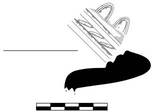
5. Gray Ware Plate (BC 50 to AD 50)
D08.0608:1. SC07-5d. Single floor sherd. Compact gray fabric, dark glossy slip on interior, unslipped outer surface. Single groove around center, single preserved ivy-leaf stamp around that, three bands of rouletting.
First published as no. 68. From disturbed layers above Augustan well-deposit.
6. Gray Ware Plate (BC 50 to AD 50)
Th. .0072.
D09.1969:9. SC08-1i. Single floor sherd, rouletting on upper surface.
7. Molded Pyxis Base (Early Roman)
P. H. .071. Est. diam. base .13 (1/6 preserved). Th. .032.
K17.0845:12. Single sherd, lower wall and single applied foot. Dark gray (Gley 1 – 10Y 3/), slightly granular fabric with tiny white inclusions visible against the dark matrix. There are also rare large lime chunks, .002 in length, flattened on the surface or visible in the break, and a single large white chunk, 4.2mm, exploding in foot; single surface void. The surface is coated dark gray (Gley 1 N 3/) where not abraded. The decorative scheme is only partially restorable. A heron leans in from the left but only its long neck and head is preserved. It is pecking at a bunch of grapes. Beneath the heron’s neck is a long stem with further vegetal design below. This left part is relatively clear. The subject is unclear to the right. It seems to be a dense thicket of vines, no human or animal forms are recognizable. The only somewhat well-defined feature is a vertical cluster which starts as one line at its bottom but becomes two. The scene is reminiscent of early first century Italian motifs.
K17.0845-12.jpg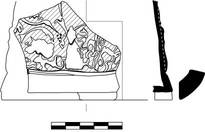
8. Gray Ware Jug Base (Early Roman)
P. H. .029. Est. diam. base .06 (completely preserved preserved). Th. .0031.
K/L16/17.0461:26. Single sherd of complete base, short grooved ring foot. Soft flakey brown (2.5YR 4/4) fabric, highly micaceous. Exterior surface is gray (10YR 4/1), darker and glossy where slip is best preserved. The interior has a spiral smoothing mark. It is noteworthy that the interior surface is very similar to the surfaces of micaceous water jars (MRA/LRA 3). This further indicates a south-west Anatolian source.
svg/K-L16-17.0461-26.jpg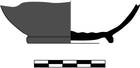
General Bibliography
Related Resources for Catalog
These links provide well-known identifiers for concepts appearing in this catalog.


